Click here to go back.
IN THE AIDS LABORATORIES
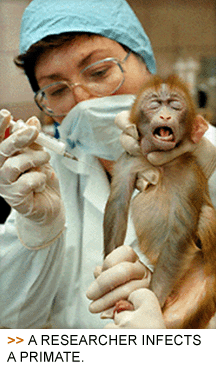
Most of AIDS research attempts to understand how HIV destroys the immune system. Possible treatments are another focus, seeking new drugs and vaccines to halt or slow the progression of the disease. These experiments often use animals, primarily cats, primates and rodents.
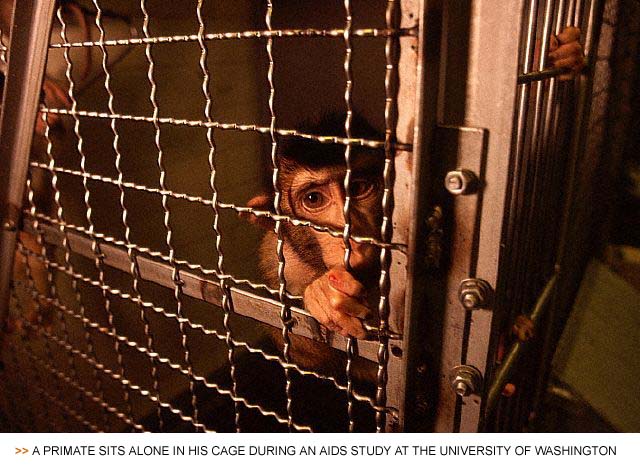
Animals in AIDS laboratories are subjected to the usual horrors of a laboratory, i.e., neglect, cruel handling, forcible restraint, painful experiments, etc. Since animals don’t get AIDS, researchers induce disease conditions that imitate AIDS in some ways, but differ greatly in others. These discrepancies do not allow accurate generalization from the animals’ conditions to the human AIDS condition. Even when given enormous doses of immunodeficiency viruses along with immune-suppressing drugs, animals still have not developed AIDS.
Cats suffer from feline immunodeficiency virus (FIV). FIV is only distantly related to HIV. The fact is FIV behaves differently from HIV at the cellular level, precisely where HIV does its damage. FIV-infected cats develop medical conditions not typically seen in HIV-infected humans. FIV behaves and affects cats differently depending on whether it was naturally acquired or laboratory-induced; natural FIV makes cats immunodeficient, but this isn’t seen in the laboratory when they are purposely infected.
More differences between FIV and HIV:
FIV is primarily transmitted through saliva, whereas HIV can not be transmitted through saliva;
FIV is widespread in wild cats but not deadly; HIV is believed to lead to AIDS and subsequent death;
Evidence suggests FIV is centuries old and has been in cats before they were domesticated, whereas HIV was discovered less than 30 years ago and is already considered a pandemic;
FIV is not transferred to offspring or other cats without certain co-factors, such as the presence of feline leukemia (FeLV), but HIV needs no co-factors to infect another person. Since FeLV itself causes serious immuno-suppression, the cat model becomes even less practical.1
Nonetheless, cats are routinely infected with various strains of HIV and FIV and given imm
une suppressing drugs. In one experiment, the NIH funded an Ohio State University study that infected cats with FIV and addicted them to methamphetamines, so as to study the effects of drug abuse on patients with HIV. Clinical and epidemiological research had already revealed accurate information about human drug addiction and HIV.2
The Vaccine Research Institute in San Diego exposes cats to morphine in order to understand the relationship between AIDS and morphine use. Morphine affects cats and humans differently: in humans, morphine is a painkiller, whereas in cats it causes maniacal excitement. Multiple, acute morphine exposure in cats did not increase the severity of early viral infection, and actually delayed or moderated AIDS progression.3 This is inconsistent with clinical studies of humans with AIDS.
Rodents are used strictly for convenience. They are inexpensive to buy and house, easy to handle and not covered by the federal Animal Welfare Act, which means they require no protocol such as the provision of adequate food or documentation. Hence, they are another preferred species in AIDS and other experiments.
Due to the countless and diverse differences between rodents and humans, experiments on rodents consistently fail to shed light on AIDS. Of the many differences between them and us, the ability to suffer is not one.
Researchers transplant HIV-1 infected human cells into genetically engineered mice with severe combined immunodeficiency (SCIDtm), but these mice don’t develop AIDS or anything similar to AIDS. Even after seven years of experiments with SCIDtm mice, researchers claimed “The potential use of (SCIDtm mice) is not yet fully established.”4 Logic decrees that seven years of failure proves the method’s inadequacy; but researchers are resistant to end something that financially supports them.
In one of countless examples of vivisectors blatantly disregarding the invalidity of their test hypotheses, they injected rats with HIV and FIV and observed their effects on the rats’ learning, sleep, and memory. Why? To learn about HIV-induced dementia.5 Since rats don’t respond to FIV and HIV similarly to humans and don’t develop AIDS, how can this experiment’s data be accurately generalized onto humans?
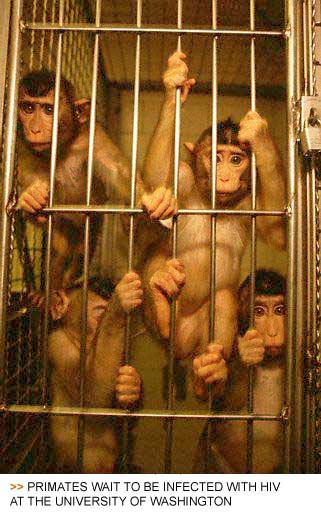
Non-human primates can acquire Simian Immunodeficiency Virus (SIV), which is quite different from HIV-1, but they never become infected with HIV naturally. Even when infected with SIV, primates respond in different ways.
The various strains of SIV appear to not cause illness when occurring naturally; however, these strains of SIV can cause immune-deficiency diseases when injected into a primate species who doesn’t naturally become infected with that strain.
Chimpanzees are the only non-humans who can be infected with HIV-1, but their bodies respond completely differently than ours:
Chimpanzees confine HIV to blood cells, but in humans HIV is found in plasma, saliva, and cerebral spinal fluid;
Chimps do not suffer from secondary opportunistic infections or cancers like humans do;
Chimps’ central-nervous systems do not manifest the changes that infected humans’ do;
HIV replicates differently at the cellular level in chimpanzees than it does in humans;
Thousands of chimpanzees have been injected with enormous doses of HIV and drugs that weaken their immune systems, yet they don’t develop AIDS. In vivisection laboratories at Yerkes Primate Research Center in Atlanta, Georgia, two chimps did become ill with flu-like symptoms, but not AIDS. One of these chimps was Jerom. The particular strain of HIV that made him sick was a mutated form that was never observed in human AIDS patients. Before Jerom was killed, he suffered from constant diarrhea and pneumonia. He was put in isolation, and was so depleted he could barely hold his head up; he would hang his head and cry.6
Despite Jerom’s immense suffering and the lack of any relevant data obtained from this experiment, Yerkes researchers injected Jerom’s blood into three other chimpanzees, causing more misery. This illogical, cruel waste of time, resources and lives is routine in the field of vivisection.
Monkeys don’t get AIDS, even when they’re infected with huge amounts of HIV and dosed with immunosuppressant drugs. Yet Yerkes Regional Primate Research Center at Emory University has wasted money and lives by working on a vaccine that prevents monkeys from developing AIDS.7
Rather than admitting defeat when HIV-infected primates yielded no similarities to HIV-infected humans, vivisectors have turned more and more to Simian Immunodeficiency Virus. Of the considerable differences between HIV and SIV, a noteworthy disparity is that SIV does not cause Simian Acquired Immunodeficiency Syndrome (SAIDS). Rather, SAIDS is a man-made illness, a feeble attempt to form an AIDS-related similarity between humans and non-humans where none exists.8 Conversely, SIV does not produce AIDS in humans--two lab technicians who were accidentally infected while working with SIV carry the virus but remain healthy.9
1. John McArdle, "Cats, AIDS, and Grantsmanship," AV Magazine (Winter 2003): 15-16.
2. McArdle,17.
3. McArdle,17.
4. Stephen Kaufman MD, Murry J. Cohen MD & Steve Simmons, "Shortcomings of AIDS-Related Animal Experimentation," n.d., <http://www.mrmcmed.org/aids.html> (February 2004).
5. McArdle,16.
6. Rachel Weiss, "Death of Jerom," n.d., <http://lpag.org/memorials/ jerom2003.html> (January 2004).
7. Yerkes Regional Primate Center, "New Multiprotein AIDS Vaccine Prevents Disease in Monkeys,” (March 2001).
8. Ray C. Greek MD & Jean Swingle Greek, Sacred Cows & Golden Geese: The Human Cost of Experiments on Animals (New York: Continuum, 2000).
9. Centers for Disease Control, "Seroconversion to Simian Immunodeficiency Virus in Two Laboratory Workers," Morbidity and Mortality Weekly Report, (11 September 1992).